 Skip to content
3D Printing in Construction: The Technology That’s Transforming the Future of Building
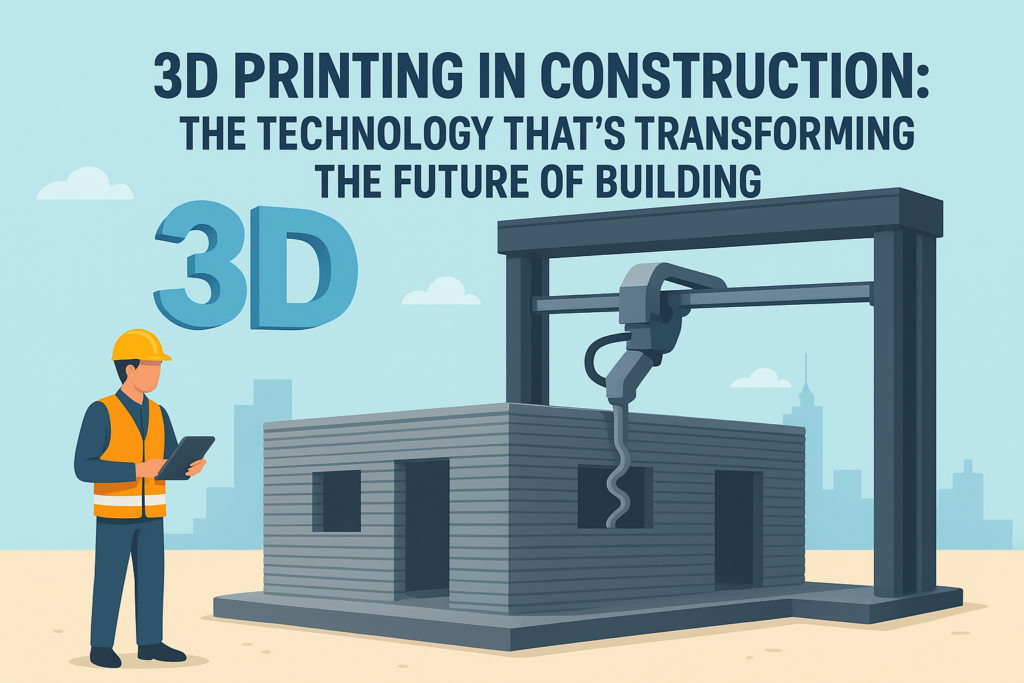
The construction world’s shifting into something fresh – fueled by smart machines, digital tools, or breakthrough materials. Of all rising techs, printing buildings layer by layer stands out as a real game-changer. It could mean speedier builds, cheaper prices, less manpower needed, yet still allow unique shapes – even when toughness and performance matter. 3D Printing in Construction
From homes printed in just one day to big buildings made with almost no hands-on work, this tech’s jumping out of test centers into actual neighborhoods. With India – and the planet – focusing on greener cities and smarter setups, 3D printing’s stepping up as a major force shaping how we construct stuff tomorrow.
What Is 3D Printing in Construction?
3D printing in construction, sometimes called additive manufacturing, builds structures one layer at a time with robotic equipment. Instead of traditional methods, these systems rely on digital designs to shape houses, barriers, or spans. They lay down concrete, plastic blends, or special pastes that harden quickly. Each level sticks right onto the last, forming solid forms without gaps. This way, whole sections go up faster than usual techniques allow
- Concrete mixtures
- Geopolymer
- Sand-based mixes
- Recycled construction waste
- Composite materials
A 3D printer squirts out stuff like toothpaste from a tube – no bricks, no molds needed. It builds exact shapes on its own, mostly hands-free. Rather than relying on workers to stack blocks, it works by laying down layers smoothly. This way, errors drop off while speed goes up.
Types of 3D Printing Technologies Used in Construction
Extrusion-Based 3D Printing
This tech’s super common when putting up houses or big buildings – people pick it ’cause it works well.
- Relies on a mix made from cement or concrete
- Machine pushes out stuff one level at a time
- Fine for walls or room dividers – also works on full exterior structures
Good for making parts that need lots of detail or special tweaks – also works when you want something unique.
- Stuff like sand or crushed rock gets piled up bit by bit
- Binder gets sprayed to form solid structures
- Perfect when you need eye-catching design elements – also works well for structural details
Additive Welding (Metal 3D Printing)
Good for factory parts or metal frames – also works in heavy-duty setups where strength matters.
- Metal wire fused one level at a time
- Fine for bridges, tricky connections – also good for support setups
Why 3D Printing is Transforming the Construction Industry
Ultra-Fast Construction
3D printers make homes in just 1 or 3 days – speeding things up a lot.
- No curing delays
- No manual bricklaying
- No complicated formwork
- This works well for large-scale homes, emergency housing, or fast city growth.
Cost-Effective Building
3D printing reduces construction costs by up to 30–60% due to:
- Less labor
- No material waste
- Faster construction
- No need to hire several separate workers
- Lower energy consumption
This opens up real chances for affordable homes – maybe now it’s actually within reach.
High Precision & Quality
3D printers work from digital designs, so they can make things just right
- Zero human error
- Perfect alignment
- Accurate dimensions
- Smooth, consistent finishing
- High structural integrity
This leads to tougher structures that stand up better.
Fully Customizable Designs
3D printing gives architects a way to try out odd shapes – ones that regular techniques can’t handle. While it opens new design options, some details still need extra work by hand.
- Curved walls
- Complex facades
- Organic shapes
- Unique room layouts
Personalizing it saves money while simplifying setup.
Sustainable & Eco-Friendly
One major plus of using 3D printing in building work? It’s kinder to the planet.
- Needs fewer resources
- You can reuse leftover building materials instead of tossing them out
- Reduces CO₂ emissions
- Fosters eco-friendly construction plans
- Minimal onsite pollution
This supports worldwide efforts to live more sustainably.
Reduced Labor Requirements
Facing a big worker gap, the building industry now needs machines more than ever – so tech steps in where people are missing.
- Fewer staff members are required now because tasks take less effort
- Safer working conditions
- Less manual labor
- Faster project completion
Printing buildings in 3D speeds things up while improving safety on site.
Where 3D Printing is Being Used in Construction
Housing Projects
Countries such as the USA, India – also the UAE – are turning to 3D printing to make low-cost housing.
- 1BHK but also 2BHK flats
- Low-cost residential units
- Mass housing colonies
Commercial Structures
Offices
- Small shops
- Warehouses
- Modular units
Infrastructure Projects
Bridges
- Footpaths
- Retaining walls
- Roadside structures
Disaster Relief Housing
Rapid building works best for:
- Flood-hit areas
- Earthquake-affected zones
- Refugee camps
Military Uses
Defense groups rely on 3D printing to build shelters fast – also setting up frontline bases without delay since tech speeds things up overall.
How 3D Printing Works in Construction (Step-by-Step)
Step 1: Digital Design
Designers build 3D versions with tools like CAD or BIM.
Step 2: Material Preparation
A unique blend of concrete gets made – often sets quicker, while staying easier to handle.
Step 3: Printer Setup
A big robot arm or frame-based machine gets set up at the location.
Step 4: Layer-by-Layer Printing
The machine squirts out stuff based on the computer plan.
Step 5: Reinforcement & Finishing
Steel bars go in first, then wiring follows once the frame’s up. Next comes plumbing – only after that does roofing get attached.
Step 6: Quality Inspection
Builders check that the building stays safe and strong over time – using solid rules they follow every step. Yet tough checks happen throughout to keep everything reliable.
3D Printing vs Traditional Construction – A Complete Comparison
| Feature | 3D Printing | Traditional Construction |
|---|---|---|
| Speed | Extremely Fast | Slow |
| Cost | 30–60% cheaper | Expensive |
| Labor | Very low | High |
| Precision | High | Variable |
| Waste | Almost zero | High |
| Design Flexibility | Very high | Limited |
| Environmental Impact | Low | High |
| Safety | High | Moderate |
3D printing beats old-school construction methods in nearly all major ways – yet it’s not always obvious why.
Real-Life Examples of 3D Printed Buildings
India’s First 3D-Printed House (IIT Madras + Tvasta)
A working one-bedroom house built in only five days using printing tech.
Dubai 3D Printed Office
World’s biggest 3D-printed office, covering 250 square meters, was built in just under three weeks – construction wrapped up after only 17 days.
USA – ICON Homes
ICON’s made lots of 3D-printed houses – some for neighborhoods, others for troops.
Amsterdam uses 3D-printed steel bridges for pedestrians and bikes.
These efforts show the tech works well, scales up easily – so it’s good to go worldwide.
Challenges of 3D Printing in Construction
Though things look good ahead, a few problems remain – yet solutions are possible if we act now
- Fairly steep price tag on equipment right away
- Want people who know how to run things
- Gov’t greenlight plus construction rules
- Limited ability to print tall structures
- Material formulation challenges
Still, scientists keep making quick progress on fixing these problems.
Future of 3D Printing in Construction
By 2035, specialists say around one-fifth to nearly a third of global building projects could involve printed structures. What’s ahead features:
- 3D-printed smart cities
- Multi-storey printed buildings
- Fully automatic building zones
- On-site robots working with AI
- Waste-free, zero-emission construction
India, along with the UAE and the US, is pumping cash into these techs – Europe’s doing the same. This shows 3D printing might take over how we build stuff sooner than expected.
